
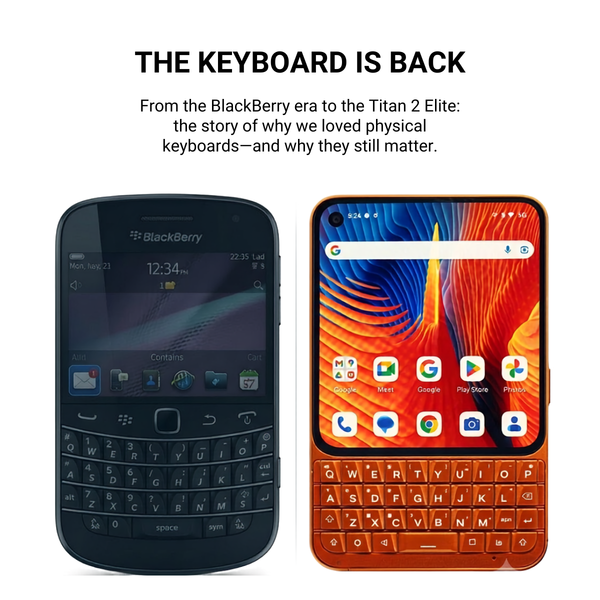
The Keyboard Is Back: Why South Africa Never Forgot BlackBerry
There was a sound that meant you were connected.
Click. Click. Click.
Before smartphones flattened into slabs of glass, millions of people carried a device you could actually feel yourself typing on. In South Africa, that device had a name everyone knew.
BlackBerry.
The Curve. The Bold. The Torch.
They were everywhere — on campus, in taxis, in boardrooms, propped on café tables next to a flat white. For a generation of South Africans, BlackBerry wasn't just a phone.
It was how you lived.
So why did we love it that much? And why, years after it vanished from shelves, is the physical keyboard suddenly making a comeback? The answer says more about us than it does about the hardware.
More Than a Smartphone
BlackBerry landed at exactly the right moment. Mobile data was opening up, smartphones were becoming affordable, and everyone suddenly wanted to be reachable — constantly.
Then came BBM, and messaging stopped being occasional. It became a habit, almost a reflex: send, see it deliver, see it read, repeat. People swapped BBM PINs the way they now swap Instagram handles.
And underneath all of it sat the keyboard — always there, always ready. You didn't look down to find a letter. Your thumbs already knew the way.
Your fingers remembered. That was the magic.
Why the Keyboard Felt So Good
Typing on glass is a small act of faith. You press, you hope, you glance down to check, you correct the typo you already knew was coming.
A physical keyboard doesn't ask for faith. You feel the key give way under your thumb. You know the letter landed before you even look. Over time your fingers stop thinking altogether — typing becomes something your hands just do.
It wasn't necessarily faster. For the people who loved it, it simply felt better — and once your muscle memory adjusts to a keyboard, going back to flat glass feels like losing a sense.
The physical keyboard was never just hardware. It was an interface you could feel.
Then Everything Changed
The iPhone arrived. Android followed. Screens grew, apps got smarter, cameras got serious — and the smartphone stopped being a communication tool and became a pocket computer instead.
BlackBerry's keyboard was still its greatest strength, but the market had already turned toward touchscreens. By January 2022, BlackBerry had officially switched off its legacy operating systems for good.
The era ended.
Or so it seemed.
The Keyboard Was Never the Problem
Here's the part most people miss: nobody was actually mourning BlackBerry the brand.
They were mourning what it made possible.
- The click of a real key
- The tactile confidence of knowing you'd typed it right
- The shortcuts, the speed, the sense of control
- A phone that felt like yours, not like everyone else's
Which raises an obvious question — one nobody in the industry seemed to be asking:
What if the keyboard wasn't a relic?
What if it just needed to grow up?
Enter Unihertz
This is where the modern keyboard phone actually begins.
Unihertz took the idea BlackBerry had proven and rebuilt it for the Android era. The result was the Titan — rugged, unapologetically different, and built around a real QWERTY keyboard instead of another glass rectangle.
It proved the obvious thing the rest of the industry had written off: there was still a community of people who wanted to feel their phone, not just stare at it.
Unihertz didn't stop there.
Four Generations, One Idea
Titan Slim refined the shape — slimmer, more pocketable, without losing the click.
Titan 2 brought the idea into the present: 5G, modern Android, a keyboard that finally matched a contemporary smartphone experience. The question shifted from "can we bring the keyboard back?" to something more interesting:
What would a keyboard phone look like if it were designed today, not resurrected from 2010?
That's not nostalgia. That's evolution.
Which brings us to now.
Titan 2 Elite
Four generations of lessons, distilled into one device:
- A more refined physical keyboard, with customisable keys
- Modern Android, running on 5G
- A high-refresh AMOLED display
- Cameras built for how people actually shoot today
- A compact build that disappears into your pocket
- The tactile feedback no touchscreen has ever managed to fake
This isn't an attempt to recreate the BlackBerry era. It's what happens when you take the one thing that era got right and build it properly, a decade later.
Why This Story Belongs Here
South Africa wasn't a footnote in the BlackBerry story — we were one of its strongholds. Students, entrepreneurs, professionals, taxi commuters: BlackBerry cut across all of it, and BBM PINs traded hands more often than phone numbers did.
That's why a QWERTY keyboard on a modern smartphone still lands differently here than almost anywhere else. For some, it's an instant flashback. For a younger generation who never touched a BlackBerry, it's something else entirely — a phone that doesn't look, feel, or behave like everyone else's.
Familiar and new, at the same time. That's a rare combination to pull off.
We're Not Bringing BlackBerry Back
We don't think the answer is rewinding the clock. Technology doesn't move backwards — but the best ideas from the past are still worth rescuing and rebuilding properly.
BlackBerry proved a physical keyboard could change how people communicate. Unihertz asked the next question: what happens when that idea meets a modern Android flagship?
Four generations later, here's the answer:
Titan → Titan Slim → Titan 2 → Titan 2 Elite
One idea. Constantly refined. Never abandoned.
The Keyboard Didn't Die. It Evolved.
Touchscreens took over. Apps transformed everything. Cameras became professional-grade. Networks got faster.
But not every good idea needs to disappear just because the industry moved on.
Sometimes you want to feel the key you're pressing. Sometimes you want to type without staring at a screen. Sometimes you want your phone to feel like a tool again — not just a window.
And sometimes, you just want something that isn't identical to everyone else's.
Welcome Back, QWERTY
If you carried a BlackBerry, you already know this feeling — the rhythm of the keys, the speed, the quiet satisfaction of a message typed without looking down once.
If you've never used a keyboard phone, there's never been a better moment to find out what the fuss was about.
The technology has moved on. The experience has been rebuilt from the ground up. And the keyboard is ready for a generation that never got to try it the first time.
Titan 2 Elite
The keyboard evolved. Now it's back.
🇿🇦 Discover Unihertz South Africa
Explore the Titan Series and the rest of our rugged, purpose-built lineup — available now, direct from South Africa's authorised Unihertz distributor.
Built for South Africa. Ready for Anything.



